Trade expert Theresa Schleicher publishes “Europe’s Economic Model 2040”
Crisis, poverty in old age, economic stagnation? — What will Europe’s thriving economy really look like in 2040?
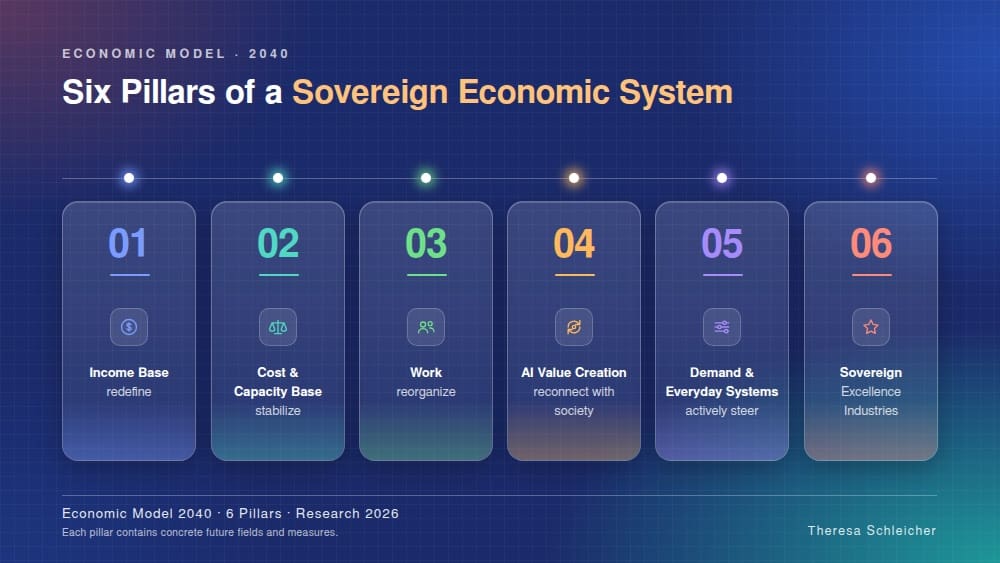
Futurist and advisor to the Federal Ministry for Economic Affairs Theresa Schleicher, together with her network of experts, has developed a well-founded and visionary scenario for the economy in 2040: a future economic model based on six pillars, designed to provide guidance and targeted, forward-looking insights—ranging from a reimagined income base and the reorganization of work to economic sectors in areas that will be successful in the future.
Theresa Schleicher says something that no one wants to hear right now:
“It’s good that the economy is faltering. It’s good that alliances are becoming unstable. It’s even okay that brands and prices are being put to the test. I don’t mean this cynically or disrespectfully, but rather as an observation that everything that’s happening right now will help us successfully navigate the coming era. And because it’s high time, things are getting tight everywhere. Strictly speaking, there are no ‘omni-’ or ‘multi-’ crises in the economy—that term implies a complete lack of direction. There is one major challenge, and several tools to solve it. However, since we aren’t using the tools properly, they themselves are becoming a source of additional problems. The challenge is urgent: to generate sufficient output and productivity with fewer resources (people and materials) to maintain security, prosperity, and well-being in Germany and Europe in 2040. When it comes to “maintaining” these things, we in Europe are actually leading the way.”
Three narratives we need to understand about our future—and that go against the usual media headlines
1. We are not lagging behind other countries; rather, we are well ahead in Europe.
Europe and Germany serve as the test market for major innovations that eventually reach everyone else. We are the most mature nation in Europe, with the highest average age of 49 (compared to 26 in Africa), the largest proportion of people in the middle class with high levels of education, and we have a largely open, socially oriented society. We face different challenges than most countries do right now—and we’re working in areas of innovation that other countries will have to tackle 10 to 20 years from now, when they’ll need solutions.
2. The climate crisis is a clear signal that we need to view the circular economy as a realistic path to growth
Anyone who experienced the sell-out of air conditioners this summer knows that when things get dicey (or “hot”) and you haven’t taken precautions, it gets expensive—and this principle applies just as much to entrepreneurs. A shift has long been underway in society.
Conserving resources doesn’t simply mean offering recycled products or reusable packaging. It means understanding availability and material flows in order to use that knowledge to build products and, above all, infrastructure and partnerships. In Europe, the construction sector alone accounts for about half of all extracted raw materials. The new economy begins with a sober assessment of the current situation.
- What materials are available in Europe, including those in existing buildings and products—often referred to as the “urban mine”?
- How reliable are the supply sources?
- What different decisions must strategic procurement make to avoid material loss throughout the entire life cycle?
Complexity researcher Peter Klimek from the Complexity Science Hub in Vienna, for example, demonstrates how production and supply networks can be empirically mapped to uncover resource and resource-processing dependencies, bottlenecks, and value losses in Europe. This finding deserves closer examination, as it is economically paradoxical.
Let’s take steel as an example. The EU is the world’s largest net exporter of steel scrap. The most important buyer is Turkey, followed by India, Egypt, and Pakistan. They purchase European scrap, melt it down into new steel using electric arc furnaces with relatively low energy consumption, and ship part of it back to Europe as rebar or finished products. The continent exports the inexpensive raw material and reimports the more expensive value-added products. There are historical and regulatory reasons why Europe continues to export this raw material. Voestalpine is now demonstrating a shift in thinking with Austria’s largest “Green Steel” project. By 2027, the company will replace part of its blast furnace operations with electric arc furnaces, which process scrap into new steel using about a quarter of the energy. The “greentec steel” program aims to reduce CO2 emissions by 30 percent while creating new jobs in the country.
3. We are currently using AI completely wrong worldwide—and throwing away trillions
The pension and aging crisis is forcing a shift toward artificial intelligence in Europe: By 2035, the German labor market alone will be short about seven million workers—and we’re talking about replacing people.
According to research by Nobel Prize-winning economist Daron Acemoglu, AI will generate a mere 0.66% in value creation because we simply aren’t using it correctly. So far, too much has been invested in pure automation and too little in strengthening human expertise and fostering new ways of thinking. AI must help rather than displace workers; this will give rise to a multitude of new industries for Europe, just as 70% of jobs will be part-time by 2040 and a large portion of new tasks will emerge.
To ensure that the value it creates benefits society, this must include value-creation funds that broadly redistribute the returns from AI, as well as moderate taxation in cases where machines completely replace human labor. What we’re doing in the debate about the future labor market is talking about sick leave and longer working hours.
Theresa Schleicher’s presentations provide an in-depth look at the 2040 economic model and what the industries of the future will look like.
Theresa Schleicher’s work draws, among other sources, on renowned studies by economists such as Daron Acemoglu, Mariana Mazzucato, Stuart Russell, and Mario Draghi.
Theresa Schleicher has already presented these findings to C-level executives, commercial enterprises, and pioneers in Europe, including the Schwarz Group and Porsche AG.
For more information about Theresa Schleicher and to request a presentation on the 2040 Economic Model, contact PREMIUM SPEAKERS at 1 (704) 804 1054 or theresa.schleicher@premium-speakers.com